
If you are buying, selling, developing, or renting out property in Kenya right now, the legal landscape you are operating in looks different from what it did twelve months ago.
The Finance Bill 2026, tabled in Parliament on April 30, 2026, introduces sweeping changes to how rental income is taxed, who must register with the KRA, and how property transfers are treated for capital gains purposes. Most of these changes take effect on July 1, 2026. For buyers, landlords, and developers, that creates an urgency that did not exist in previous property cycles.
This is precisely why property lawyers in Kenya are doing more for their clients in 2026 than simply drafting transfer documents. This article explains what they do, what that costs, and the five vital things you need to confirm, including Finance Bill 2026 complianc, before any transaction proceeds.
Table of Contents
What Property Lawyers in Kenya Actually Do
The formal term is conveyancing, the legal process by which ownership of land or property transfers from one person or entity to another. But in Kenya, conveyancing encompasses far more than preparation of transfer documents.


Here is what a properly engaged property lawyer handles across a standard transaction:
Due diligence and title investigation. Your advocate runs an official search at the relevant land registry, reviews the history of the title, verifies the identity and authority of the seller, and checks for all registered encumbrances, cautions, and caveats. For properties in Nairobi, this may involve both the city county registry and Ardhi House, depending on the age and category of the title.
Sale agreement review and negotiation. The sale agreement is the binding contract that governs the transaction from deposit to completion. Your lawyer reviews or drafts this document, negotiates terms around deposit conditions, completion timelines, default provisions, and vacant possession, and ensures your interests are protected before you sign.
Regulatory clearances. Land rates (payable to the county government) and land rent (payable to the National Land Commission for leasehold properties) must both be confirmed as current before completion. Your advocate obtains the required clearance certificates and manages this process.
Tax compliance under the Finance Bill 2026. This is a new but increasingly significant component of the property lawyer’s role in 2026. The Finance Bill proposes that the residential rental income tax rate increases from 7.5% to 10%, that a new non-resident rental income tax applies to foreign landlords, and that mandatory KRA registration and monthly digital filing become obligations for all qualifying landlords. For buyers acquiring income-generating property, an advocate should now confirm the tax compliance history of the property before transfer, because KRA liabilities follow the asset, not the seller.
Stamp duty assessment and payment facilitation. Stamp duty, charged at 4% of the market value of the property in municipalities and 2% in rural areas, is assessed by the Kenya Revenue Authority and must be paid before any transfer documents can be registered. Your advocate manages this process, including obtaining the stamp duty assessment and facilitating payment.
Leasehold consent. For leasehold property, which includes most apartments and many commercial parcels in Nairobi, consent to transfer must be obtained from the National Land Commission before registration can proceed. Your advocate manages this application, which takes time and must be submitted correctly to avoid delays.
Registration and title transfer. The final step is registration of the transfer at the land registry, producing a title deed in your name. Your advocate presents all executed documents, pays the required fees, and follows through to ensure you receive the updated title deed confirming your ownership.
For commercial transactions, development projects, or leases, the scope expands further: drafting development agreements, structuring joint ventures, managing planning applications, and advising on Finance Bill 2026 implications for portfolio structuring.
What Property Lawyers in Kenya Cost in 2026

Legal fees for conveyancing are governed by the Advocates Remuneration Order, which sets a minimum scale based on property value. The scale is broadly progressive, starting at approximately 1.25% of the first KES 2 million of consideration and reducing proportionally for higher-value transactions.
As a practical guide:
- For a property at KES 5 million: advocate’s fees of approximately KES 65,000–85,000
- For a property at KES 10 million: approximately KES 100,000–130,000
- For a property at KES 25 million: approximately KES 150,000–200,000, depending on complexity
These are professional fees only. In addition to your advocate’s charges, you should budget for the following disbursements:
- Stamp duty: 4% of property value in municipalities (including all of Nairobi), 2% in rural areas
- Land registry fees: typically KES 5,000–20,000 depending on the transaction type
- Official land search fees: modest, but payable per search
- NLC consent fees: applicable for leasehold transfers
- Survey fees (if a physical survey is required): varies by property size and location
The Finance Bill 2026 may also add a new cost consideration. For buyers acquiring rental properties, tax compliance advisory work, confirming the property’s KRA status, understanding the new rental income obligations, and structuring the acquisition to avoid inheriting undeclared liabilities, is now a legitimate component of the legal engagement. Ask your advocate whether this falls within their retainer scope or requires a separate engagement.
Always request a full written fee and disbursement breakdown before engagement begins. The professional fee and the disbursements serve different purposes and go to different parties, you should understand both clearly before the transaction starts.
5 Vital Things to Check With Your Property Lawyer in Kenya
1. That they have run an official search — not reviewed the seller’s copy
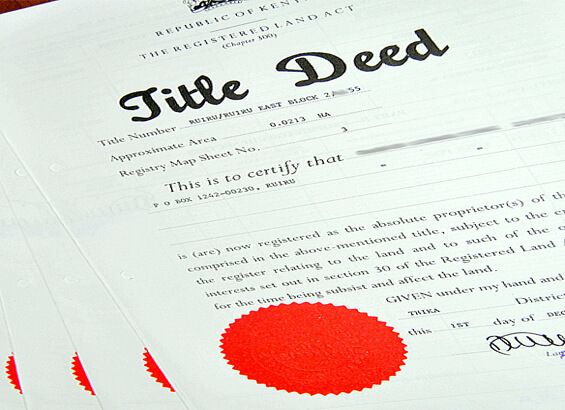
The seller’s title deed can be forged, outdated, or incomplete. An official search result issued directly from the land registry to your advocate is the authoritative document, and it is the only basis on which your legal position can be confidently assessed. Confirm that the official search has been conducted and ask to be briefed on the results.
2. That the NLC consent process is actively in hand
For leasehold property, which covers most apartments and many commercial properties in Nairobi, consent to transfer from the National Land Commission is a legal requirement before registration can occur. This consent application takes time and must be submitted correctly. If your advocate has not initiated or planned for this, your completion timeline will not hold. Ask early where the consent process stands.
3. That the sale agreement protects your deposit
If you have paid or are about to pay a deposit, the sale agreement must clearly state what happens to that money if the transaction does not complete, particularly if a title defect discovered during due diligence is the reason. Your deposit should be fully refundable in those circumstances. If the agreement does not say this clearly, it needs to be negotiated before you sign, not after.
4. That zoning approvals match your intended use of the property
Property lawyers in Kenya should confirm that the planning and zoning designation for your property is consistent with how you intend to use it. This matters not only for greenfield development but for modifications to existing structures, changes in commercial use category, or intensification of an existing use. A simple check at the outset costs far less than a change of use application, or worse, a demolition order, at a later stage.
5. That the transaction is structured correctly under the Finance Bill 2026
This is the vital check that distinguishes well-advised transactions in 2026 from those that will create problems in the months that follow.
The Finance Bill 2026, if enacted as proposed, changes the tax landscape for Kenyan property in the following ways relevant to buyers:
- Rental income tax rate increase: Resident landlords earning annual rental income between KES 288,000 and KES 15 million will pay tax at 10% from July 1, 2026, up from 7.5%. The KRA has simultaneously introduced mandatory landlord registration and monthly digital filing obligations, replacing the previous annual self-assessment approach.
- Non-resident rental income tax: Foreigners or foreign companies earning rental income from Kenyan properties are now brought directly into the tax net under the proposed section 6B of the Income Tax Act. This is a final tax, once paid, no further returns are required on that income. Non-resident landlords must register with the KRA and remit tax by the 20th day of the month following the month in which rent is received.
- KRA enforcement posture: The KRA has publicly identified hundreds of thousands of property owners in Nairobi, Mombasa, and Kisumu who are currently outside the tax net, and has committed to using AI-driven income cross-referencing to enforce compliance. The risk of inheriting undeclared rental income obligations from a seller is real and measurable.
- CGT and stamp duty exemption for REIT transfers: On the positive side, the Finance Bill introduces an exemption from both capital gains tax and stamp duty for property transferred to a registered Real Estate Investment Trust. For institutional investors and portfolio holders, this is a meaningful structuring opportunity that 2026 presents.
Your property lawyer should be actively checking all of this, not just the title and the agreement. If they are not, ask them directly — and read our fuller breakdown in: Property Lawyers in Nairobi: 8 Critical Things to Confirm Before You Sign Anything.
Property Transactions Outside Nairobi: What Changes



Kenya’s property market extends well beyond the capital, and the Finance Bill 2026 applies nationally. Whether you are buying in Mombasa, where the coastal strip has historically distinct title documentation and specific Land Control Board requirement, in Kisumu, Nakuru, Eldoret, or Thika, the same core legal framework applies.
What changes is the local registry process, the familiarity of the acting advocate with the specific county’s procedures, and in some cases the applicable land control or development authority. Agricultural land transactions in Kenya’s counties require Land Control Board consent under the Land Control Act, a separate process that adds time and requires careful management.
If you are transacting outside Nairobi, ensure your property lawyers in Kenya either have direct experience in that county or have established relationships with local counsel who do.

Thomas Louis Advocates advises individual buyers, developers, foreign investors, and corporate clients on property matters and Finance Bill 2026 compliance across Kenya and East Africa. If you are buying, selling, or managing property in 2026 and want to understand how the new tax landscape affects your specific transaction, contact our team here.
Frequently Asked Questions
Are property lawyers in Kenya required by law? Under the Advocates Act, conveyancing, the preparation, review, and registration of property transfer documents, must be carried out by a licensed advocate. The land registry will not register a transfer based on documents not prepared by an admitted advocate. In practice, you cannot complete a property purchase in Kenya without one.
What does the Finance Bill 2026 change for landlords in Kenya? The Finance Bill 2026 proposes to increase the residential rental income tax from 7.5% to 10% for resident landlords earning between KES 288,000 and KES 15 million annually. It also introduces a brand new non-resident rental income tax for foreign landlords. Both are proposed to take effect from July 1, 2026, alongside mandatory KRA landlord registration and monthly digital filing obligations.
What is stamp duty on property in Kenya and who pays it? Stamp duty is a government tax assessed by the Kenya Revenue Authority. In municipalities, including Nairobi, it is charged at 4% of the market value of the property. In rural areas, the rate is 2%. It is normally paid by the buyer, unless otherwise negotiated, and must be settled before any transfer documents can be registered at the land registry.
How do I know if a property I am buying has outstanding KRA liabilities? This is a due diligence question your advocate should be able to answer. With the Finance Bill 2026 increasing enforcement posture around rental income, your advocate should confirm the compliance history of any income-generating property before transfer is finalised. If the current owner has unpaid rental income tax obligations, those should be settled by the seller prior to completion.
What is the difference between an advocate’s fee and stamp duty? The advocate’s fee is the professional charge for the legal work carried out on your transaction. Stamp duty is a government tax paid to the Kenya Revenue Authority. Both are normally payable by the buyer, but they are separate obligations paid to entirely different parties. A transparent fee breakdown from your advocate will show both clearly.