
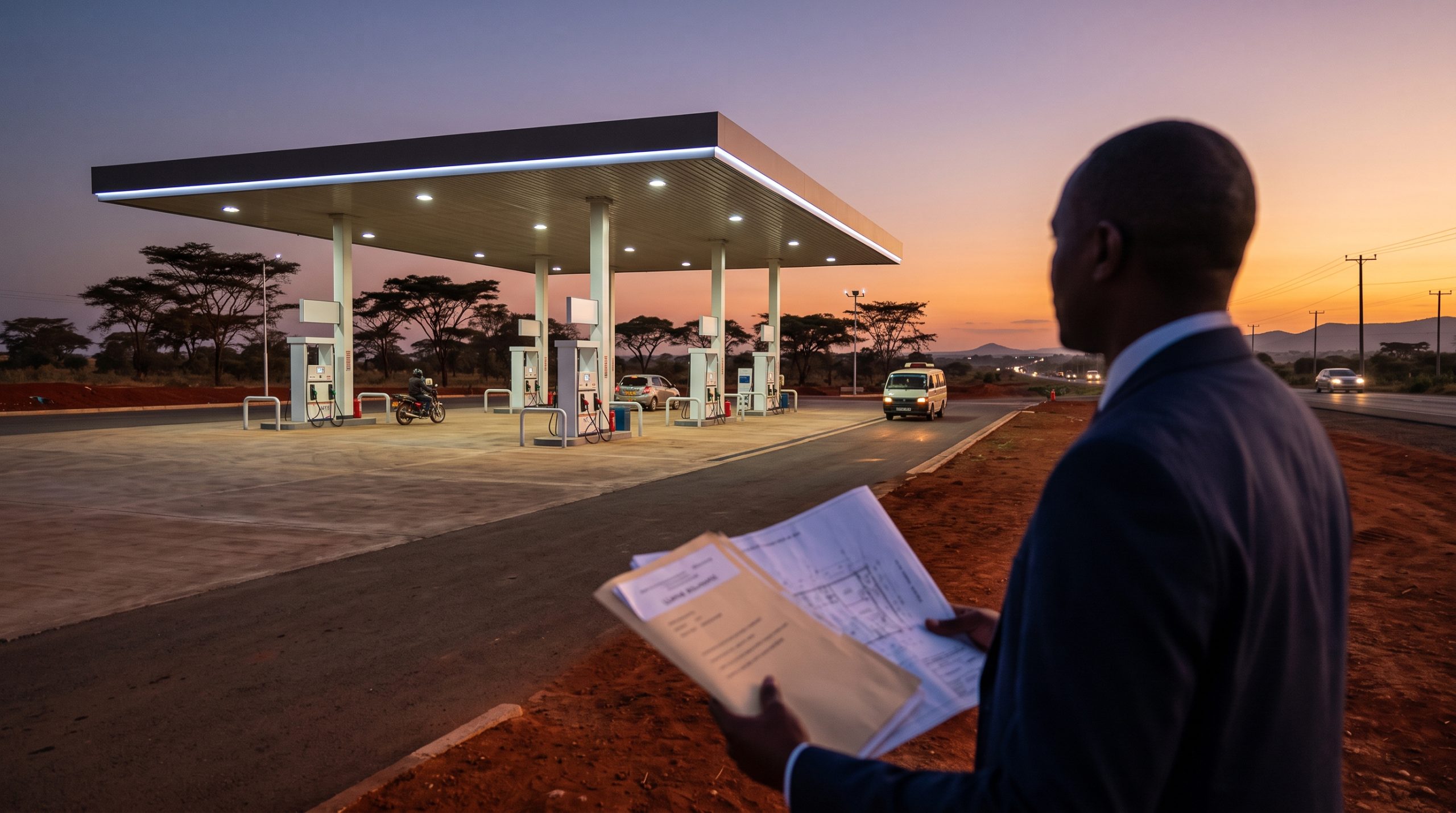
Anyone planning to open a petrol station in Kenya must clear two separate approvals from the Energy and Petroleum Regulatory Authority (EPRA): a construction permit to build the site, and a retail business licence to sell fuel from it. Each is assessed against different criteria, at different stages of the project, under the Petroleum Act, 2019 and the Petroleum (Retail Dispensing Site Construction and Licensing) (No. 2) Regulations, 2025.
This guide sets out every stage of EPRA petrol station license in Kenya, from pre-construction clearances to the day-to-day compliance obligations that follow once your licence is granted.

Phase 1: Pre-Construction Approvals and Permits for a Kenyan Fuel Station
Before construction begins, a developer must secure clearance from several regulatory bodies. Getting this phase right is the single biggest determinant of whether an EPRA construction permit application succeeds.
1. Business Registration
Provide a Certificate of Incorporation, a current CR12 (issued within the last year), and identification for all directors, submitted through the EPRA licensing portal.
2. Land and Zoning Requirements
Prove ownership with a title deed or, where title has not yet been issued, an allotment letter or a registered lease of at least five years — together with development permission from the County Physical Planning Office.
3. The Statutory Minimum-Distance Rule
A statutory minimum-distance rule applies to every new fuel station site: it cannot sit within 2 km of another station (existing or under construction) along a Class A road, or within 500 m along any other road class. Testing this before acquiring land is critical — a rejection on site-unsuitability grounds is final, subject only to appeal to the Energy and Petroleum Tribunal, and cannot be cured with stronger paperwork elsewhere.
4. Road Authority Approval
Obtain approval for access, and for acceleration/deceleration lanes, from the relevant roads authority — KeNHA, KURA, or KeRRA — depending on the road’s classification.
5. Environmental Impact Assessment (EIA) Licence
Secure an EIA licence from the National Environment Management Authority (NEMA). Treat this as a precondition to filing the construction permit application, since it is typically the longest-running approval in the entire sequence.
6. The EPRA Construction Permit Application
Submit the prescribed application with civil, mechanical, and electrical engineering drawings (tanks, pipework, forecourt, and drainage), each signed off by an engineer holding a current practising certificate from the Engineers Board of Kenya, plus a priced bill of quantities and the executed environment liability policy.
- The permit is valid for 12 months from issue, extendable to a maximum of 24 months.
- Building without a permit is an offence under section 74(3) of the Petroleum Act.
- EPRA may suspend or revoke a permit under section 89.
Important compliance point: before issuing the permit, EPRA notifies the applicant of the conditions it intends to impose. The applicant then has 30 days to return a signed written undertaking accepting those terms. Missing this window renders the permit void — construction is lawful only once the signed permit is actually issued, not upon receipt of the notification.
Phase 2: Construction and Safety Standards for Petroleum Retail Sites
Who May Build
The permit holder must:
- engage only contractors registered by the National Construction Authority for the applicable class of work;
- keep the project under continuous supervision by an Engineers Board of Kenya–certified engineer; and
- comply with the NEMA-approved environmental mitigation plan.
Physical Works
Construct underground storage tanks, oil interceptors, and a concrete forecourt to the applicable Kenya Standard (Kenya Bureau of Standards specifications), with drainage built exactly as approved in the permit drawings.
Safety Installations
Fit certified firefighting equipment, sand buckets, and adequate facility lighting specifications.
Phase 3: The EPRA Retail Licence Application
The retail licence is applied for once construction is substantially complete, because most of the supporting documentation is evidence of the finished, operational facility rather than the plan for it.
Required Documentation
- A valid KRA Tax Compliance Certificate
- The county Single Business Permit for the specific premises
- A NEMA EIA licence covering the completed facility
- A county Fire Clearance Certificate
- A certificate of compliance under the Physical and Land Use Planning Act, 2019
- Registration of the site as a workplace with the Directorate of Occupational Safety and Health Services (DOSH)
- Calibration certificates for every storage tank and for the dispensing pump meters (the latter from the Department of Weights and Measures)
- A pressure test report for tanks and pipelines
- A colour photograph of the frontage and forecourt
- A summary emergency response plan
- The executed environment liability policy
- A supply arrangement with a licensed oil marketing company or wholesaler
Submission, Review, and Renewal
File through the EPRA portal. EPRA must review a complete application within 30 days, and must give written reasons for any rejection within seven days. The licence carries an expiry date and is renewed under section 77 of the Petroleum Act after one year from the date of issuance.
A caution on the county permit: the Single Business Permit is only one item on EPRA’s checklist — it is not itself authority to trade. Its issuance by the county does not, on its own, authorise the sale of petroleum products without the EPRA retail licence.
Ongoing Compliance for Licensed Fuel Retailers
Once granted, the EPRA retail licence establishes an ongoing regulatory relationship. Licensees must:
- sell only product meeting the applicable Kenya Standard;
- source exclusively from a licensed petroleum business;
- keep pumps calibrated; and
- avoid under-dispensing, hoarding, or selling above EPRA-determined prices.
EPRA Petrol Station Licensing Fees and Timelines
Under the Sixth Schedule to the Regulations, both the construction permit and the retail licence attract statutory application fees, charged separately for each approval:
| Application Type | Fee |
| New registration | KES 5,000 |
| Renewal | KES 2,000 |
| Amendment | KES 1,000 |
These statutory fees are a small fraction of the total cost — the real investment sits in the engineering, environmental, and county approvals that sit beneath them.
Common Mistakes That Delay or Derail a Fuel Station Licence in Kenya
Based on recurring issues in EPRA petroleum licensing matters, the most common pitfalls are:
- Breaking ground on EPRA’s notification of conditions, rather than waiting for the signed, issued construction permit.
- Assuming a site is “close enough” to a competitor to survive the statutory distance test, which EPRA applies strictly.
- Treating the NEMA EIA as a parallel workstream instead of the precondition it actually is to filing the construction permit application.
- Assuming a granted construction permit predicts a granted retail licence. The completed facility is tested afresh — calibration, fire clearance, and workplace registration are all assessed independently of what was approved at permit stage.
How Thomas Louis Advocates Can Help You Get A Petrol Station License in Kenya
Navigating EPRA’s two-tier permit-and-licence system — alongside NEMA, county planning, road authority, and DOSH requirements — is a multi-agency process where a single missed deadline (like the 30-day undertaking window) can void months of work. The Oil and Gas practice at Thomas Louis Advocates advises investors, developers, and fuel retailers on structuring, sequencing, and executing petrol station licensing applications in Kenya from site due diligence through to first day of trading.
Prepared by Thomas Louis Advocates. This article is for general information only and is not legal advice. Statutory fees, timelines, and thresholds should be confirmed against the current Regulations and directly with EPRA before you rely on them.
Read More on how The National Bank of Ethiopia Widens The Net on What Counts as a Prohibited Virtual Asset Activity
Frequently Asked Questions
How long does it take to get a petrol station licence in Kenya?
There is no single fixed timeline — it depends on how quickly land, zoning, road authority, and NEMA approvals are secured. However, once a complete retail licence application is filed, EPRA must review it within 30 days.
Can I start building before EPRA issues the construction permit?
No. Construction is lawful only once the signed, issued permit is in hand — not upon receiving EPRA’s notification of proposed conditions. Building beforehand is an offence under section 74(3) of the Petroleum Act.
How close can a new petrol station be to an existing one in Kenya?
EPRA applies a minimum-distance rule of 2 km from another station along a Class A road, or 500 m along other road classes. This should be verified against your specific site before land is acquired.
Does a county Single Business Permit let me sell fuel?
No. The county Single Business Permit is one supporting document among many — it does not itself authorise fuel sales without the separate EPRA retail licence.